The automotive industry is experiencing its most profound transformation in over a century. What was once a gradual, decade-by-decade evolution of internal combustion engines has shifted into a rapid digital and electrical revolution. At the heart of this shift is the convergence of high-capacity energy storage, sophisticated computing architectures, and pervasive cloud connectivity.
Driven by global decarbonization mandates, evolving regulatory standards, and shifting consumer expectations, the push toward electric vehicles and automotive technology innovation is no longer a niche market strategy—it is the central driver of the modern auto economy. Modern automobiles are rapidly morphing from complex mechanical machines into dynamic, connected software platforms on wheels. Understanding this transformation requires looking closely at the core advancements altering how vehicles are designed, built, and driven.
The Rapid Rise of Electric Vehicles
The transition toward electric mobility has accelerated dramatically in recent years. Global sales of battery electric vehicles (BEVs) and plug-in hybrid electric vehicles (PHEVs) have expanded from early-adopter enthusiasm into broad commercial adoption across major auto markets.
                     GLOBAL EV MARKET SHARE SHIFT

   [2017]  ■■ 1.4%
   [2021]  ■■■■■■■■ 8.3%
   [2023]  ■■■■■■■■■■■■■■ 15.8%
   [2025]  ■■■■■■■■■■■■■■■■■■■■■■■ 25.0%

   0%        5%        10%       15%       20%       25%       30%
Several key factors drive this momentum:
-
Regulatory Compliance: Strict emissions limits and zero-emission mandates in the European Union, China, and various U.S. states have required automakers to pivot toward electrified portfolios.
-
Expanding Model Portfolios: Automakers have expanded their lineups beyond luxury sedans to include high-volume vehicle categories, such as compact crossovers, full-size pickup trucks, and commercial vans.
-
Cost Parity Convergence: Advanced manufacturing scaling and falling pack-level battery costs are bringing initial purchase prices of EVs closer to parity with comparable internal combustion engine (ICE) vehicles.
Battery Technology Is Transforming EVs
Batteries represent the single most important factor in EV range, cost, and overall performance. As the core energy storage system of an electric vehicle, battery engineering has seen major technical advances over the last decade.
                    EV BATTERY TECH EVOLUTION

   ┌─────────────────────────────────────────────────────────┐
   │ 1. Lithium Iron Phosphate (LFP)                         │
   │    Cobalt-free | Lower cost | High cycle life           │
   └────────────────────────────┬────────────────────────────┘
                                │
                                ▼
   ┌─────────────────────────────────────────────────────────┐
   │ 2. Nickel Manganese Cobalt (NMC)                        │
   │    High energy density | Longer range | Premium segment │
   └────────────────────────────┬────────────────────────────┘
                                │
                                ▼
   ┌─────────────────────────────────────────────────────────┐
   │ 3. Solid-State / Semi-Solid Electrolytes                │
   │    Non-flammable | 400+ Wh/kg target | 10-min fast charge│
   └─────────────────────────────────────────────────────────┘
Lithium-Ion Chemistries
Lithium Iron Phosphate (LFP) chemistries have gained widespread adoption in standard-range and entry-level vehicles due to their lower manufacturing costs, longer cycle life, and elimination of nickel and cobalt. Meanwhile, high-nickel chemistries, such as Nickel Manganese Cobalt (NMC), remain the standard for long-range and high-performance applications where maximizing volumetric energy density is essential.
Solid-State Innovations
Solid-state batteries—which replace liquid or gel electrolytes with solid ceramic, polymer, or sulfide-based media—represent a major leap forward for energy storage. While full commercial mass production of all-solid-state cells is still entering early deployment phases, semi-solid-state cells have already entered field testing and limited production.
| Battery Architecture | Energy Density | Thermal Stability | Primary Advantage | Status |
| Conventional LFP | 160–200 Wh/kg | High | Low cost, high durability | Commercialized |
| High-Nickel NMC | 250–300 Wh/kg | Moderate | High range per weight | Commercialized |
| Semi-Solid State | 300–380 Wh/kg | High | Improved safety, density | Early Deployment |
| All-Solid-State | 400+ Wh/kg (Target) | Very High | Rapid charging, non-flammable | Pilot Testing / R&D |
Faster Charging and Infrastructure Expansion
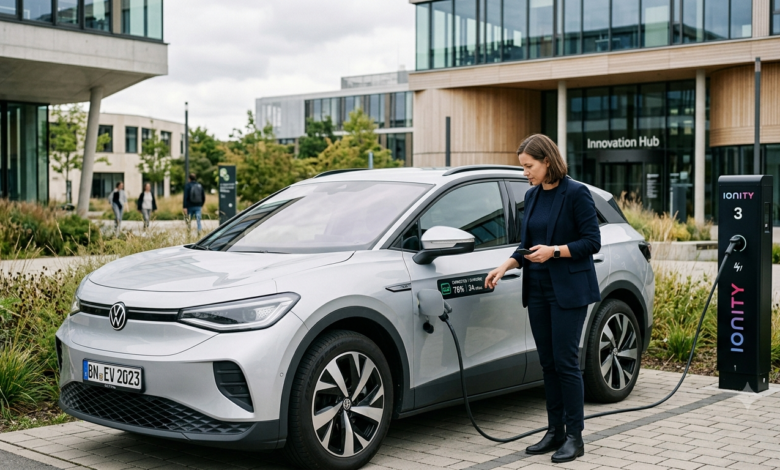
For mass EV adoption to succeed, public and private charging infrastructure must match the convenience of traditional gas stations. The ecosystem is evolving through both hardware upgrades and network standardization.
-
High-Voltage Architectures: Automakers are increasingly shifting from 400-volt to 800-volt powertrain architectures. This doubling of system voltage allows vehicles to draw up to 350 kW of direct current (DC) fast charging, replenishing 10% to 80% state-of-charge in approximately 15 to 18 minutes when connected to compatible hardware.
-
Standardized Connectors: The industry is moving toward unified plug standards—such as the North American Charging Standard (NACS)—allowing drivers across different vehicle brands to access shared high-speed charging networks seamlessly.
-
Megawatt Charging Systems (MCS): Designed for heavy-duty commercial trucks and long-haul buses, MCS technology delivers over 1 megawatt of power, enabling rapid recharging during mandatory driver rest intervals.
Artificial Intelligence Is Making Cars Smarter
Modern vehicles process massive amounts of sensor data in real time, making artificial intelligence (AI) and machine learning foundational to modern electric vehicles and automotive technology.
Predictive Energy Management
AI algorithms continuously analyze real-time variables—including topography, traffic congestion, ambient temperature, and personal driving style—to optimize power consumption, predict remaining battery range accurately, and pre-condition battery packs prior to reaching a fast-charging station.
Intelligent Cabin Assistants
In-vehicle AI interfaces have evolved beyond basic voice command recognition. Natural language processing models allow occupants to adjust climate controls, navigate routes, and control media naturally, reducing visual and cognitive driver distraction.
Autonomous and Advanced Driver-Assistance Technologies
The path toward full vehicle autonomy is structured around defined engineering levels set by SAE International, ranging from basic safety alerts to complete automation.
                  LEVELS OF VEHICLE AUTOMATION

   [Level 1]  Driver Assistance (Adaptive Cruise)
   [Level 2]  Partial Automation (Lane Centering + Cruise)
   [Level 2+] Advanced L2 (Hands-Off, Eyes-On Road)
   [Level 3]  Conditional Automation (Hands-Off, Eyes-Off in specific conditions)
   [Level 4]  High Automation (Geofenced Autonomous Robotaxis)
   [Level 5]  Full Automation (Any condition, no human input)
Commercial Availability vs. Development Stage
Currently, Level 2 and Level 2+ systems are widely available in production vehicles. These advanced driver-assistance systems (ADAS) integrate adaptive cruise control, lane-centering steering, and automatic lane changes, though they still require the driver to remain fully attentive.
Level 3 systems, which allow drivers to disengage attention under specific geofenced highway and low-speed traffic conditions, are available in select luxury vehicles under specific regional regulatory approvals. Meanwhile, Level 4 technologies operate commercially primarily in dedicated, geofenced autonomous robotaxi fleets and commercial hub-to-hub trucking routes, rather than consumer-owned personal vehicles.
Software-Defined Vehicles and Over-the-Air Updates
The shift toward the Software-Defined Vehicle (SDV) represents a fundamental change in automotive engineering. Historically, vehicles relied on dozens of standalone Electronic Control Units (ECUs) provided by different suppliers, each running static code.
         LEGACY ECU ARCHITECTURE vs. MODERN ZONAL ARCHITECTURE

   Legacy Distributed Architecture       Modern Zonal SDV Architecture

     [ECU 1] ─── (Door Module)                [Central Computing Cluster]
     [ECU 2] ─── (Brake System)                           │
     [ECU 3] ─── (Infotainment)              ┌────────────┴────────────┐
     [ECU 4] ─── (HVAC Control)              ▼                         ▼
     [ECU 5] ─── (Lighting)           [Front Zone Controller]  [Rear Zone Controller]
   (50-100+ separate units,             │                        │
    complex physical wiring)            └── Sensors/Actuators    └── Sensors/Actuators
Modern SDVs consolidate these disparate units into centralized high-performance domain or zonal computer platforms. Benefits include:
-
Over-the-Air (OTA) Updates: Automakers can deploy software patches, security updates, feature enhancements, and efficiency improvements remotely, keeping the vehicle updated throughout its lifecycle.
-
Simplified Harnessing: Moving to zonal architectures reduces physical wiring harness length and vehicle mass, improving overall assembly efficiency and energy economy.
-
Feature-on-Demand Capabilities: Software centralization enables configurable options, allowing owners to unlock performance enhancements, cabin amenities, or advanced safety features after purchase.
Connected Cars and Vehicle-to-Everything (V2X) Technology
As vehicles become increasingly connected, Vehicle-to-Everything (V2X) communication allows cars to exchange data with their surrounding environment in real time.
                              V2X ECOSYSTEM

                              [Cloud Infrastructure]
                                        ▲
                                        │
                                        ▼
    [Other Vehicles] ◄──(V2V)──► [Connected EV] ◄──(V2I)──► [Traffic Signals]
                                        ▲
                                        │ (V2G / V2H)
                                        ▼
                             [Smart Grid / Home Energy]
-
Vehicle-to-Infrastructure (V2I): Cars communicate with traffic signals, road sensors, and smart city infrastructure to optimize traffic flow, reduce idling time, and alert drivers to upcoming road hazards.
-
Vehicle-to-Vehicle (V2V): Direct inter-vehicle communication enables cooperative safety applications, such as real-time blind-spot alerts and sudden-braking warnings beyond the line of sight.
-
Vehicle-to-Grid (V2G) and Vehicle-to-Home (V2H): Bidirectional power flow transforms EVs into mobile energy storage units. During peak demand or emergency power outages, vehicles can feed energy back into the power grid or supply home appliances, supporting broader grid stability.
New Automotive Manufacturing Technologies
The shift toward electrification has transformed manufacturing plants and assembly processes.
-
Large-Scale Structural Casting: Pioneered to reduce body assembly complexity, mega-casting merges dozens of stamped sheet-metal components into single, highly rigid structural castings for front and rear vehicle underbodies. This process reduces vehicle weight, cuts factory floor footprint, and lowers manufacturing complexity.
-
Integrated Cell-to-Pack (CTP) and Cell-to-Chassis (CTC): Traditional battery designs group individual cells into modules, which are then installed inside a battery pack casing. Advanced CTP and CTC architectures bypass intermediate modules, mounting cells directly into the chassis structure. This maximizes energy density, increases structural rigidity, and lowers overall pack mass.
How Traditional Automakers and EV Specialists Are Adapting
The transition to software-defined electric vehicles has altered competitive dynamics across the global automotive sector.
               INDUSTRY TRANSFORMATION: INCUMBENTS VS. SPECIALISTS

    Legacy Automakers                         Pure-Play EV Companies
    ─────────────────                         ──────────────────────
    • Massive global scale                    • Clean-sheet architecture
    • Complex engine supply chains            • In-house software integration
    • Capital-intensive retooling             • Direct-to-consumer sales model
    • Transitioning existing factories        • Fast iteration cycles
Legacy OEMs bring deep manufacturing expertise, global distribution networks, and strong brand equity to the transition. However, they face the financial challenge of funding dual powertrain development while retooling legacy factories. Conversely, pure-play EV startups and technology entrants benefit from clean-sheet vehicle architectures and vertically integrated software stacks, though they often face scaling challenges when expanding production capacity.
Navigating Challenges: Cost, Supply Chains, and Infrastructure
Despite technical progress, the auto industry faces several key operational hurdles during this transitional period:
-
Affordability and Residual Values: High upfront battery costs still elevate entry prices for consumers in certain vehicle segments. Additionally, rapid technological updates create market uncertainty regarding long-term used vehicle valuations.
-
Raw Material Supply Chains: Securing reliable, ethical, and localized supplies of critical battery minerals—such as lithium, nickel, cobalt, and graphite—remains a major geopolitical and industrial challenge.
-
Public Grid Capacity: Widespread EV adoption requires substantial utility investment to upgrade distribution transformers, substations, and localized grid capacity to handle concentrated residential and commercial fast-charging loads.
Environmental Sustainability and Production Impacts
While electric vehicles generate zero tailpipe emissions during operation, calculating their total environmental impact requires a complete lifecycle assessment (LCA).
                      LIFECYCLE CARBON EMISSION COMPARISON

   Internal Combustion Engine (ICE)
   [Manufacturing] ░░░░░░░
   [Operational Emissions - Fuel Burning] ▓▓▓▓▓▓▓▓▓▓▓▓▓▓▓▓▓▓▓▓▓▓▓▓▓▓▓▓▓▓▓▓▓▓▓

   Battery Electric Vehicle (EV - Average Grid)
   [Manufacturing (incl. Battery)] ░░░░░░░░░░░░░░
   [Operational Emissions - Grid Power] ▓▓▓▓▓▓▓▓▓▓

   Battery Electric Vehicle (EV - Clean Energy Grid)
   [Manufacturing (incl. Battery)] ░░░░░░░░░░░░░░
   [Operational Emissions] ▓▓
The manufacturing phase of an EV currently generates a higher carbon footprint than an equivalent ICE car, driven by energy-intensive battery mineral extraction and cell manufacturing. However, over the vehicle’s operational lifecycle, an EV yields significant net reductions in greenhouse gas emissions—a gap that widens continuously as national electricity grids transition toward renewable energy sources. Furthermore, closed-loop battery recycling initiatives are retrieving up to 95% of critical metals from end-of-life battery packs, reducing reliance on raw mineral mining over time.
The Future of Mobility: What Consumers Can Expect
As the auto industry continues its structural shift, the consumer mobility experience will evolve across several key areas:
-
Smarter, Personalised Cabins: Vehicles will function increasingly as connected digital spaces, offering personalized media displays, artificial intelligence assistants, and seamless integration with personal devices.
-
Faster Charging and Greater Range: Continued advances in cell chemistries, aerodynamics, and thermal management will make 300+ mile real-world range and sub-15-minute fast charging standard across most price tiers.
-
Flexible Ownership Models: Software-defined architectures enable flexible ownership and subscription-based mobility options, alongside traditional purchasing and leasing structures.